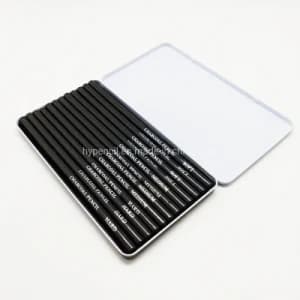
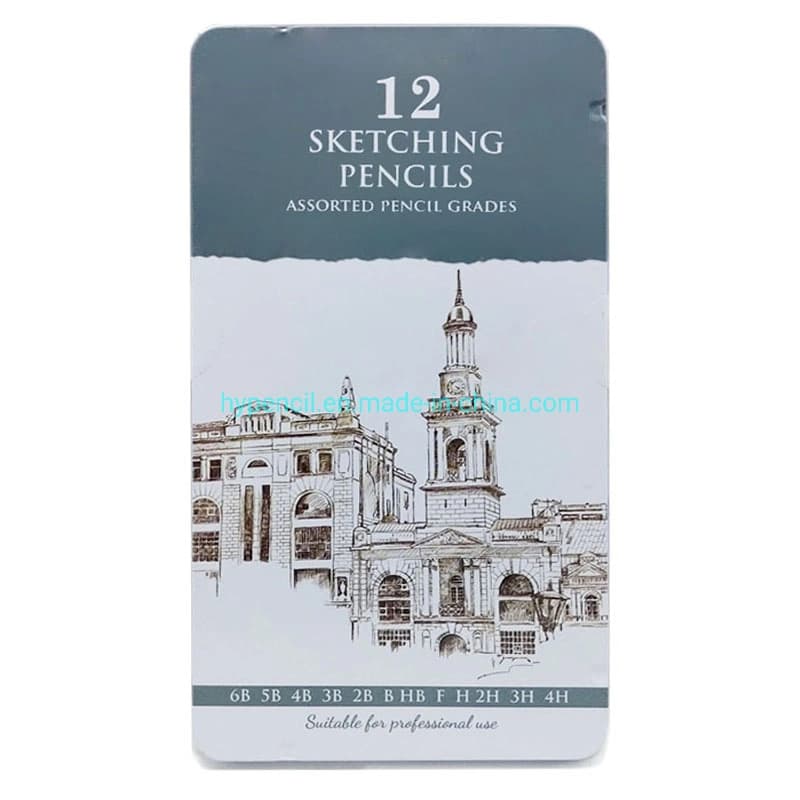
Charcoal pencils put compressed charcoal — the deepest black a dry medium can lay down — inside a wooden barrel. They come in soft, medium, and hard grades, plus a colored family of white, sanguine, and sepia. We manufacture them at Hongyun Penindustry in Qingyuan, Zhejiang; here is how the grades work and what to check before a bulk order.
Compressed Charcoal: What Is Inside the Barrel
A charcoal pencil core starts as charcoal dust — willow and linden are the classic sources — mixed with a binder and compressed into a rod. The binder ratio is the grade. Soft grades carry less binder: darker, velvetier blacks, faster wear, a crumblier point. Hard grades carry more: lighter marks, a point that survives detail work, and a core that stands up to classroom handling. There is no single "best" grade, which is why the retail unit is a set — the tonal ladder from soft to hard is the product.
Two relatives sit beside it. Willow and vine sticks are pure burned wood with no binder: lighter blacks, fully erasable, and so brittle they arrive in boxes padded like eggs. Compressed charcoal blocks sit at the other end — maximum black, maximum fragility, workshop tool rather than retail SKU. The wood-cased charcoal pencil is the civilized middle: clean hands, a sharpenable point, and a format that survives a school bag. For a retail buyer it is also the only one of the three that merchandises itself, because the tin does the talking that a box of loose sticks cannot.
One factory note that buyers rarely get: grade consistency is the hard part of charcoal production. Graphite darkness is tuned with clay, a mature and forgiving process. Charcoal depth swings with the binder ratio and even with the burn of the source wood, so batch-to-batch consistency is a quality system, not an ingredient list.
Charcoal vs Graphite: Where Each One Wins
The two dry drawing mediums divide the work by instinct. Graphite is silver, shiny, and precise — it holds a needle line, renders metal and glass, and reads as document. Charcoal is matte, crumbly, and expressive — it goes darker than graphite can reach, covers a sheet in seconds, and smudges on purpose. Under gallery lighting the difference is immediate: graphite catches the light and sheens back; charcoal stays a dead-flat black no matter where the viewer stands.
Charcoal's structural advantage is reworkability. A kneaded eraser lifts charcoal all the way back to clean paper — graphite leaves a ghost. Portrait artists exploit this constantly: block the mass, wrong by a centimeter, lift it entirely, redraw. Graphite forgives nothing in comparison. The trade runs the other way too. Charcoal will never hold a 0.5 mm line or survive being treated like a writing instrument. Anyone who needs precision hatching stays with graphite; anyone who needs depth and speed works in charcoal. Most finished drawings use both, which is why they are merchandised as neighbors.
The Colored Charcoal Family: White, Sanguine, Sepia
"Colored charcoal" is a family, not one product, and knowing the members sells sets. The white charcoal pencil is the mirror tool: a compressed white core — pigments of the titanium-white type in a charcoal-style binder — built for highlights on toned or black paper. Draw the dark masses in black charcoal, then turn the paper's forgotten half of the value range on with white. Lettering on black paper, moonlight, glass reflections: the white charcoal pencil does work no graphite can, because graphite on black reads as gray scratch.
Sanguine and sepia carry the classical tradition. Sanguine, the red-oxide earth tone, and sepia, the deep brown, are the descendants of the Renaissance drawing toolkit — used with white on cream or gray paper in the "three chalks" method that portrait academies have taught for four centuries. Modern conté crayons cover the same color ground with a waxier, oil-based formula; the charcoal-family versions stay powdery and smudgeable, which matters to artists who blend with a finger or a stump. On mid-toned paper, a sanguine shadow, a sepia midtone, and a white highlight produce a drawing that reads warm and human in a way pure graphite never manages.
Scope note, stated plainly because this guide is written by the manufacturer: our standard charcoal program ships black — soft, medium, and hard in the 12-piece tin. White, sanguine, and sepia variants are quoted as custom OEM configurations on the same platform. If your program needs the colored family as a standing SKU, that is a specification conversation, not a catalog line — bring the color count and the target shelf price.
Four Techniques That Define Charcoal Work
Charcoal technique is value discipline. The medium rewards people who think in masses and punishes people who think in lines — here are the four moves that carry almost all charcoal teaching.
Tone first, line second. Block the big value structure with the side of the pencil before any contour hardens. Dark areas go dark early, because everything downstream is calibrated against them. A charcoal drawing that starts with outline detail is a drawing that runs out of depth halfway through.
Lift, don't add. The kneaded eraser is half the medium. Press it on a dark passage and the tone comes up; dab repeatedly and the paper returns nearly white. Experienced artists draw as much with the eraser as with the pencil — pulling a highlight out of a finished shadow instead of trying to reserve it. That reverse-drawing capability is the single biggest difference from ink or digital habits.
Layer the grades in order. Hard and medium grades build the structure; the soft grade arrives last. A soft core deposits its deepest black immediately and cannot be walked back — so it goes on at the final stage, for the three or four darkest accents that define the whole image. Soft charcoal used early is soft charcoal wasted. (The same rule governs the deepest graphite grades, for the same reason.)
Smudge with intent. Fingers, paper stumps, and chamois move charcoal the way brushes move paint. The controlled version: soften an edge by dragging tone outward with a stump, then re-harden the near edge with a sharp medium. In a retail demo, the sequence tone-lift-smudge-highlight takes ninety seconds and answers the question every buyer actually has — "what does this do that my normal pencils don't?"
Three companion tools decide whether the techniques land, and they sell on the same shelf as the set. A kneaded eraser is the lifting tool — it must be soft enough to press, not rub. A paper stump moves tone without adding finger oil, which repels later layers. And a sandpaper block keeps the point: charcoal points blunt fast, and the dust from re-pointing on sandpaper can be swept back into the drawing as free pigment — a studio habit that stretches a 12-piece set further. For retail, the same three tools are the natural add-on basket beside the tin: the customer who buys them is the customer who actually uses the set.
The Fragility Problem: Barrel, Moisture, and Transit
A compressed charcoal core is more fragile than any graphite core, and everything about the product's engineering follows from that sentence. In production, the barrel has to hold the core without pinching it: poplar slats are sorted for grain uniformity around the core, and the wood is kiln-dried to 8–12% moisture because a barrel that swells or shrinks after assembly cracks the core it carries. Slats arriving outside the moisture range go back through drying before they touch the pencil line — a delay the schedule absorbs, because the alternative is a container of pencils that snap in the sharpener.
Transit is the second half of the problem. Charcoal sets that ship in flimsy packaging arrive as expensive fragments, and freight insurance does not un-break cores. This is why the retail format is a rigid tin with each pencil immobilized, and why the 12-piece tin is the platform Hongyun Penindustry quotes wholesale programs on. The tin is also the shelf: it survives being opened a hundred times in a shop, which paper boxes do not. For education channel programs where sets live in classroom drawers, the tin is not an upgrade — it is the minimum viable package.
The counter-intuitive part for first-time charcoal buyers: the grades most likely to arrive broken are the soft ones, the exact grades the artist wants most. A supplier's transit record on soft grades is therefore a better quality signal than any brochure.
Specifying a Wholesale Charcoal Set
The configuration decisions compress into four lines. Grade mix: education programs weight the set toward hard and medium, because soft cores frustrate beginners and die in classroom sharpeners; portrait and fine-art retail weight it toward soft, because the deep black is what the customer is buying. Count: 6-piece for trial and promo, 12-piece as the standard academic format, 24-piece for the dedicated fine-art shelf. Barrel: FSC-certified poplar to 175 mm with the moisture spec stated — the line that separates a quoted process from a quoted price. Packaging: printed tin for retail, with the artwork quoted as part of the OEM program rather than as an afterthought.
Our 12-piece charcoal pencil tin set is the platform those decisions hang on — soft, medium, and hard compressed charcoal in a rigid tin, quoted from 5,000 sets with a 30–35 day production window. It sits in a wider drawing-pencil range alongside graphite sketch sets on the wooden pencils page, and the wood-specification background for both is covered in our guide comparing barrel materials for bulk orders. Qingyuan County Hongyun Penindustry Co., Ltd. has produced wooden-cased pencils since 2004 — the charcoal line runs on the same platform and the same documentation stack as every barrel we ship to more than 50 countries.
Custom grade mixes, colored variants, and private-label tins go through custom pencil OEM — and every Hongyun Penindustry program, standard or custom, starts the same way: request a sample, run the four techniques above on the actual cores, and judge the grades against your own gold sample before the bulk order is placed.