Hongyun — pencilschina.com
  • Pencils
  • Compliance
  • OEM & Custom
  • Learn
  • About
Request Sample
  1. Home/
  2. Blog/
  3. Color Pencils/
  4. Sourcing Color Pencils for European Retail: The Complete Guide

Sourcing Color Pencils for European Retail: The Complete Guide

A practical checklist for sourcing color pencils for European retail — covering EN71-3, REACH, wood quality, SRP packaging, and OEM factory evaluation.

Sourcing GuideBy David Wu, CEO12 April 20267 min read

European retail color pencil orders fail when EN71-3 reports, REACH declarations, FSC scope, or barcode packaging are checked too late. Before you approve a set, verify pigment safety, wood species, SRP or PDQ format, sample performance, and retailer documentation.

EN71-3 and REACH: The Two Non-Negotiable Standards

EN71-3 and REACH — the two chemical safety frameworks every color pencil supplier must meet: Any color pencil manufacturer supplying European retail channels must demonstrate compliance with two overlapping EU chemical safety frameworks. EN71-3 sets migration limits for 19 chemical elements — including barium (1,500 mg/kg), cadmium (1.3 mg/kg), chromium VI (0.053 mg/kg), and lead (13.5 mg/kg) — measured in mg/kg of dry material for the brittle/powder category that color pencil cores fall into. REACH operates in parallel, restricting substances of very high concern (SVHCs) across the entire product supply chain, specifically applicable to barrel lacquer, ferrule adhesive, and pigment binders in color pencils. A compliant supplier must hold current EN71-3 migration test reports from a CNAS- or ILAC-accredited laboratory — not older than 12 months — with separate test documentation for each pigment color, and provide REACH compliance declarations for each component upon request. Test reports at item level are mandatory — each SKU sold into Europe requires its own documentation.

Ask for test reports at item level, not category level. Each SKU sold into Europe needs its own documentation. ISO 9001 certification indicates the factory runs documented production and quality control procedures, which makes test repeatability more reliable.

Core Quality Indicators: Pigmentation, Diameter, and Break Resistance

  • Pigmentation intensity: Pencils that require more than three strokes to achieve full opacity on 80 gsm paper will generate returns from end consumers. Ask your manufacturer for drawdown samples across the full color range before approving production.
  • Core diameter and centering: A core that is not centered in the barrel will break at the sharpener on the first use. Specify core diameter (standard 3.3 mm for children's ranges, 4.0 mm for artist grades) and request a cross-section check from at least 20 random samples per shipment.
  • Break resistance: Express the requirement as a minimum load threshold — typically ≥150g for school-grade cores. A credible wholesale supplier will include break resistance data in their standard quality report.

Browse our full color pencil range to see how these specifications are documented at the product level.

Wood Species and Barrel Quality: What Matters for European Buyers

For bulk order color pencils entering European general retail, two wood species dominate:

  • Basswood (椴木): The premium standard. Clean sharpening, low splintering risk, consistent grain. Specify "selected knots-free basswood, moisture content 8–12%."
  • Poplar (杨木): The value option for high-volume, economy-range programs. Acceptable sharpening performance when properly kiln-dried. Specify kiln-dried poplar with moisture content ≤12%.

Also confirm that the surface lacquer is water-based and REACH-compliant. See our wooden pencil production standards for comparable specification documentation.

Packaging Compliance: SRP, PDQ, and Barcode Requirements

  • SRP (Shelf Ready Packaging): Required by high-turnover discounters (Lidl, Action, Aldi). The outer box must display a scannable barcode on three sides and meet the retailer's specific tray dimensions.
  • PDQ (Pre-Loaded Display Quantity): A free-standing display unit for stationery importers and mid-tier retailers. More flexible on dimensions.

Barcodes must be GS1-registered EANs. If you need custom OEM packaging with your own brand identity, request a dieline template from the factory and confirm it against your retailer's packaging specification sheet before production begins.

Retail Documentation Checklist Before You Approve the PO

Before issuing the purchase order, align the compliance file with the approved sample and the final retail pack. A European color pencil program should not move to mass production until these documents are complete:

  • Safety file: item-level EN71-3 migration report for every SKU and color set, plus a REACH declaration covering pigments, lacquer, binder, and adhesive.
  • Factory file: current FSC scope if claimed, BSCI audit status, and ISO 9001 certificate issued to the producing factory.
  • Packaging file: GS1 EAN proof, SRP or PDQ dieline, carton marks, barcode placement, and retailer artwork approval.
  • Approval file: PPS or gold sample sign-off, then a PSI trigger tied to AQL criteria before shipment release.

How to Run a Pre-Order Quality Evaluation

  • Request item-level test reports — EN71-3 and REACH, dated within 12 months, from an accredited lab.
  • Order a pre-production sample (PPS) — minimum 3 complete sets per color variant. Evaluate pigmentation, sharpening, core centering, and barrel roundness.
  • Run a pre-shipment inspection (PSI) — AQL 2.5 for major defects, AQL 4.0 for minor defects.
  • Verify certification documentation — FSC chain-of-custody and BSCI audit report should be issued to the factory, not a trading company.

If you are uncertain about any stage, contact our team — we provide full documentation packages as standard on every export order.

Key Evidence

What EN71-3 migration limits apply to color pencil pigments: EN71-3 (2013+A1:2014) sets migration limits in mg/kg of dry material for 19 elements. Color pencil cores fall into the dry/brittle/powder category. Key limits include: barium 1,500 mg/kg, cadmium 1.3 mg/kg, chromium (VI) 0.053 mg/kg, and lead 13.5 mg/kg. These are migration limits — not total content limits. Always request migration test reports, not total content XRF screening. Any EN71-3 certified color pencil supplier should be able to provide these reports within 48 hours of a request.
What is the standard MOQ for a custom color pencil set with OEM packaging: For custom OEM color pencil sets with printed barrel and retail-ready packaging, the typical minimum order quantity from a China factory is 3,000 to 5,000 sets per SKU. Lower MOQs (500–1,000 sets) are possible for standard barrel colors with only outer packaging customisation, but they carry a per-unit premium of 15–25% versus standard MOQ pricing. Bulk order programs above 50,000 sets per SKU typically qualify for dedicated production scheduling and compressed lead times of 25–30 days ex-works. For seasonal programs targeting European retail windows, initiate the order no later than 16 weeks before your required delivery date.
How do I verify that a color pencil supplier's FSC certification is current: FSC certificates are publicly verifiable in the FSC Certificate Search database at search.fsc.org. Enter the supplier's FSC certificate code (format: [country code]-COC-[6-digit number]) to confirm the certificate is active and covers the product group that includes color pencils. Note that an FSC logo license is separate from a COC certificate — a supplier can hold a logo license without a COC, which does not satisfy documentation requirements for colored pencil set wholesale supplier programs entering major European retail chains. Our FSC certification page includes our current certificate number and a direct verification link.

External Reference Check

External reference check: Color-pencil compliance should be verified against the FSC certificate database and EU REACH restricted substances before a retail-ready set is approved.

Final Thoughts

For European retail, color pencil sourcing starts with item-level EN71-3 reports, REACH screening, FSC proof, packaging format, and approved samples. Compare our color pencil range and plan custom packs through custom pencil OEM.
Related Reading

  • Top 8 Pencil Manufacturers in China: 2026 Factory Comparison Guide
  • EN71 vs ASTM D4236: The Complete Guide to Pencil Safety Standards
  • Is Pencil Lead Poisonous? What Every B2B Buyer Must Verify Before Importing
Share:LinkedInFacebookX (Twitter)Email

Article last reviewed 5 July 2026. Specifications and market conditions may change — verify current requirements with our team.

Detailed FAQs

What BSCI audit grade do European retailers require for pencil suppliers?

BSCI (Business Social Compliance Initiative, now amfori BSCI) audits social compliance in supplier factories — working hours, wages, health and safety, freedom of association. Auditors assign a grade from A (outstanding) through E (unacceptable). For major European retailers, grade C or better is the minimum gate; grade A or B is commonly required for full private-label approval.

Grade thresholds as applied to supplier qualification:

  • Grade A (Outstanding) — Very rare in practice. Typically only held by the largest, most systemically audited factories.
  • Grade B (Good) — Typical requirement for large European retail private-label programs (Auchan, Carrefour, Lidl, Kaufland private brand).
  • Grade C (Acceptable) — Minimum bar for most mid-tier importers and wholesale buyers. Factories at grade C must present a corrective action plan with a defined re-audit timeline.
  • Grade D / E — Disqualifying for almost all retail buyers. Some importers accept D on a one-time basis if a corrective action is already in execution, but this is high-risk for your supply chain.

pencilschina.com holds a current BSCI audit at grade C. Request the audit report directly with your RFQ — the report is confidential and shared only with qualified buyers under NDA, not posted publicly, because it contains factory-level operational data.

Important caveat: BSCI audits are valid for one to two years depending on the previous grade. Always confirm the audit date is within the valid window before placing an order. Expired BSCI documentation will not pass retail supplier-qualification software (Sedex, EcoVadis, SupplierIQ).

See our BSCI certification page or the full BSCI audit explainer.

Are pencilschina.com pencils EN71 and REACH compliant?

Yes. All pencilschina.com pencils intended for sale in the European Union comply with EN 71-3 (Safety of Toys — Migration of Certain Elements) and REACH Regulation (EC) No 1907/2006 restrictions for consumer products. Test reports are available per batch on request.

EN 71-3 coverage: EN 71-3 limits the migration of 19 elements — including lead (Pb), cadmium (Cd), chromium (Cr), barium (Ba), and antimony (Sb) — from the paint and surface coatings of products accessible to children. For pencils, the painted barrel, foil, and tip (ferrule) are all within scope. The test is performed on scraped coating samples and is a mandatory requirement for any product marketed to EU consumers under the age of 14.

REACH coverage: REACH restricts specific substances of very high concern (SVHC) across all consumer articles. For pencils, the key restricted substances are certain phthalates (in grips/erasers), azo dyes (in colour pencil cores and coatings), and heavy metals. Our supply chain is screened annually against the updated REACH Candidate List.

Test report format: reports are issued by SGS, Intertek, or TÜV (accredited third-party labs) and include:

  • Sample description with batch code
  • Test date and report date
  • Element-by-element migration results in mg/kg
  • Pass/fail judgement against the EN 71-3 limit
  • Lab accreditation reference

Reports are valid for the specific batch and production date tested. For private-label buyers, we recommend running fresh tests at least annually and on significant formulation changes (new core supplier, new paint lot). For US market exports, the equivalent standard is ASTM F963 plus CPSIA heavy-metal limits — tests covering both EU and US standards can be requested in a single report.

See our EN71 vs ASTM D4236 comparison or request a recent test report with your sample request.

How does EUDR affect pencil imports into Europe from 2026 onward?

The EU Deforestation Regulation (EUDR, Regulation (EU) 2023/1115) requires operators and traders placing listed commodities — including wood and wood products — on the EU market to prove, through documented due diligence, that the commodity was not produced on land deforested after 31 December 2020 and that production complied with the laws of the country of origin.

Pencils fall under HS Code 9609 (pencils, crayons, pencil leads, pastels, drawing charcoals). The wood slats used in pencil manufacturing are in scope for EUDR.

Current application timeline (based on the European Commission EUDR page checked on 2026-07-06; confirm again before ordering because the Regulation has been amended):

  • Large and medium operators: compliance required from 30 December 2026
  • Micro and small operators: compliance required from 30 June 2027
  • Micro and small operators already covered by the EU Timber Regulation: compliance required from 30 December 2026

What due diligence means in practice for a pencil importer:

  1. Geolocation data — You must collect geographic coordinates of the plot(s) of land where the wood was harvested. For pencil slats from Chinese factories, this means your supplier must trace back to the forest source. FSC CoC certification supports but does not fully substitute for EUDR requirements; you will need supplementary documentation.
  2. Risk assessment — Document the risk of deforestation-linked sourcing. The EU publishes a country risk benchmark; check the current Commission classification for the harvest country before filing.
  3. Due diligence statement — File a statement with the EU central register before placing the product on the market. Each statement covers a specific consignment.

What pencilschina.com provides: plot-level geolocation for our FSC-certified wood sources, a structured due diligence dossier per shipment, and direct export documentation aligned with EUDR Annex I requirements. For buyers not yet set up with due diligence workflows, our documentation package can be used as the primary evidence layer in your EUDR compliance file.

Read the full EUDR pencil import guide, or contact our export team to request a sample due diligence dossier.

What's the difference between HB and 2B pencil grades, and which should I order?

HB and 2B are the two most widely ordered pencil grades on the European graphite scale. The difference is the ratio of graphite to clay inside the pencil core, which directly affects darkness, sharpening behaviour, and break resistance.

  • HB — approx. 70% graphite / 30% clay. Medium hardness, balanced darkness, holds a point well, resists smudging. This is the universal default for writing, exam pencils, and OMR/bubble-sheet answer pencils.
  • 2B — approx. 55% graphite / 45% clay (inverted ratio). Softer, darker line, smudges more easily, wears down faster. Preferred for sketching, shading, and some Asian-market school systems where darker writing is the standard.

Measurable performance differences (tested per ISO 9180 pencil quality method):

  • Core break resistance: HB typical ≥ 200g force, 2B typical ≥ 150g force (softer cores break earlier under lateral load)
  • Lead wear rate: 2B wears approximately 30–40% faster than HB at equivalent writing pressure
  • Writing darkness (reflectance density): HB ~0.55, 2B ~0.85 (higher = darker)

Decision rules for B2B buyers:

  • European/UK school supply, office writing, bubble-sheet exam pencils → HB (the dominant SKU, 70–80% of Western school-supply mix)
  • Chinese, Japanese, Korean school markets → 2B is the cultural default for primary-school writing (shift to HB from grade 4–5 in some curricula)
  • Art-retail sets, sketching kits → Include both (typical art set: 2H / H / HB / B / 2B / 4B / 6B, 6–8 grades per tin)
  • Promotional/giveaway pencils → HB unless the brand has a specific reason otherwise — it fails less in the hands of casual users

pencilschina.com produces HB, 2B, and the full 9H–9B scale on request. Standard SKUs ship from stock; custom-grade orders have 3,000 pcs MOQ. See the full HB vs 2B grade guide for procurement decision rules by market.

How do I verify a Chinese pencil factory's FSC certificate is real?

FSC certificate fraud is a real risk in low-cost stationery sourcing — a number of Chinese exporters display FSC logos on product photos or websites without holding a valid Chain of Custody certificate. Verification takes less than two minutes and should be done before sending any RFQ.

The official FSC public database is at search.fsc.org. It is free, does not require an account, and returns results in real time. Every legitimate FSC-certified supplier is listed there; if a factory is not in the database, the certificate is either expired, suspended, or was never valid.

Three ways to verify:

  1. By certificate code — Ask your supplier for their CoC code (format: XXXX-COC-XXXXXX). Enter it in the database search. pencilschina.com's code is ESTS-COC-251233 — paste it and you will see our active certificate record.
  2. By company name — Search the factory's registered business name in English or pinyin. A matching active record will appear with the scope, product types covered, and validity date.
  3. By scope — Confirm the certificate scope explicitly mentions pencils or relevant wood products. A supplier with FSC for paperboard packaging but not for pencil manufacturing is not authorised to sell FSC pencils to you.

Red flags: suppliers who resist providing a code, send only a cropped PDF, or list a code that returns "no matching certificate" in the database. In all three cases, request an audit trail or disqualify the supplier.

See our FSC certification page or read the full verification walkthrough.

What is the typical MOQ for custom pencils from a Chinese factory?

The typical minimum order quantity (MOQ) for custom-branded pencils from a professional OEM factory in China is 3,000 to 5,000 units per SKU. Standard catalogue items without customisation may be available at lower quantities — sometimes as low as 1,000 units — but anything involving custom tooling, artwork setup, or colour matching hits the 3,000 pcs floor.

Why MOQs exist at this level:

  • Artwork setup cost — One-time logo plate/film charge is typically USD 20–80 per design. Below 3,000 units this setup cost alone drives unit price up by 20–40%.
  • Production batching — Pencil painting and heat-transfer printing lines run in shifts sized for minimum batch efficiency. A 500-unit run is physically possible but economically unattractive.
  • Colour matching — Pantone colour matching requires paint mixing in a minimum volume. Once mixed, the remaining paint cannot be stored indefinitely.

At pencilschina.com, MOQ policy is:

  • Standard catalogue pencils: from 1,000 pcs per style
  • Custom-printed pencils (logo or artwork): 3,000 pcs per SKU
  • Fully custom OEM (shape, foil, tipping, box): 5,000 pcs per SKU
  • Custom colour pencil sets (non-standard palette): 10,000 pcs per SKU

For small buyers or market testing, we recommend starting with a standard catalogue item plus custom outer packaging (sleeve/display box) — this keeps unit cost competitive while letting you brand the retail experience. See our custom OEM page for the full process, or request samples before committing to an order.

What custom packaging options are available for OEM pencil orders?

Custom pencil packaging falls into four categories, each suited to different retail channels and buyer profiles. The packaging format you choose determines your retail placement, unit cost, shelf presentation, and logistics efficiency — select it before approving artwork, not after production starts.

1. SRP — Shelf-Ready Packaging (for discount retail chains). SRP is the standard format for European non-food discount chains including Action, Tedi, Pepco, and Lidl. The outer carton converts directly into a display tray — perforated tear-off lid, product facing forward, barcode on three sides. No repacking required at store level. SRP cartons are designed to fit standard European retail shelf depths (300mm, 400mm, or 500mm). Typical configuration: 12–24 pencils per SRP tray, with each pencil secured in a die-cut slot. The barcode must be EAN-13 format, registered through GS1, and scannable on three sides of the outer carton. SRP adds roughly USD 0.02–0.05 per pencil in packaging cost compared to bulk — the cost is recovered in reduced in-store handling labour at the retailer end.

2. Blister Card (for supermarket hanging displays). A transparent PVC or PET blister attached to a printed cardboard backer card with a euro-hole for pegboard hanging. Common in supermarket stationery aisles and promotional product displays. The backer card is full-colour offset printed with your branding, barcode, and compliance markings. Standard formats: single pencil blister, 2-pack, 4-pack, or 6-pack. PVC-free blister options (PET or PLA) are available for retailers with plastic reduction commitments. Blister card packaging adds approximately USD 0.03–0.08 per unit depending on card size, print complexity, and blister material.

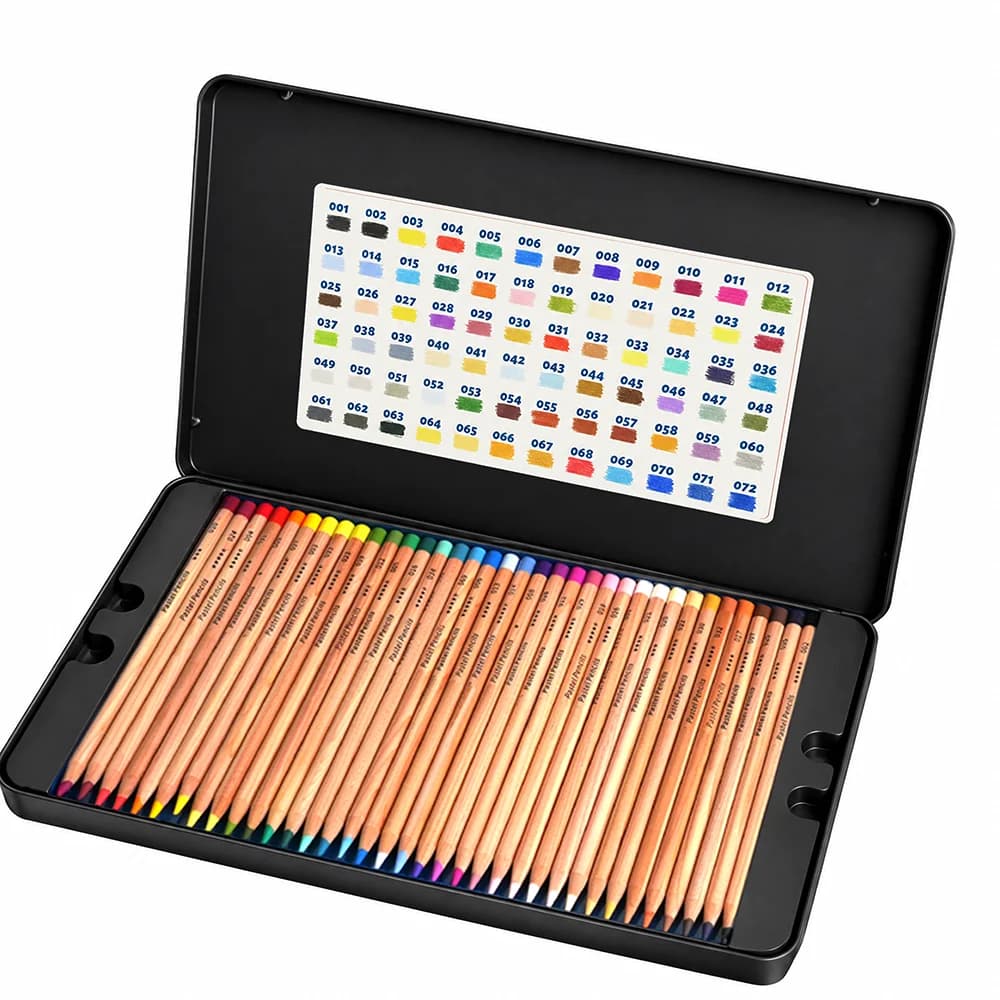
3. Tin Box (for gift sets and seasonal programmes). Metal tin box with a hinged or slide lid, foam or cardboard insert with die-cut slots for each pencil. Used for premium coloured pencil sets (12–72 colours), Christmas gift sets, and Back-to-School premium ranges. Tin boxes are manufactured to custom dimensions — typical formats: 12-colour flat tin (180 × 90 × 15mm), 24-colour double-layer tin (190 × 100 × 25mm), 36-colour triple-layer tin (200 × 110 × 35mm). Full-colour offset printing on the tin exterior with your artwork. Tin box packaging adds approximately USD 0.15–0.50 per unit depending on tin size, insert complexity, and print coverage. The perceived value uplift at retail — a tin-boxed 24-colour set typically retails at 3–5× the price of the same pencils in a cardboard box — makes tin packaging the preferred format for gifting and premium ranges.

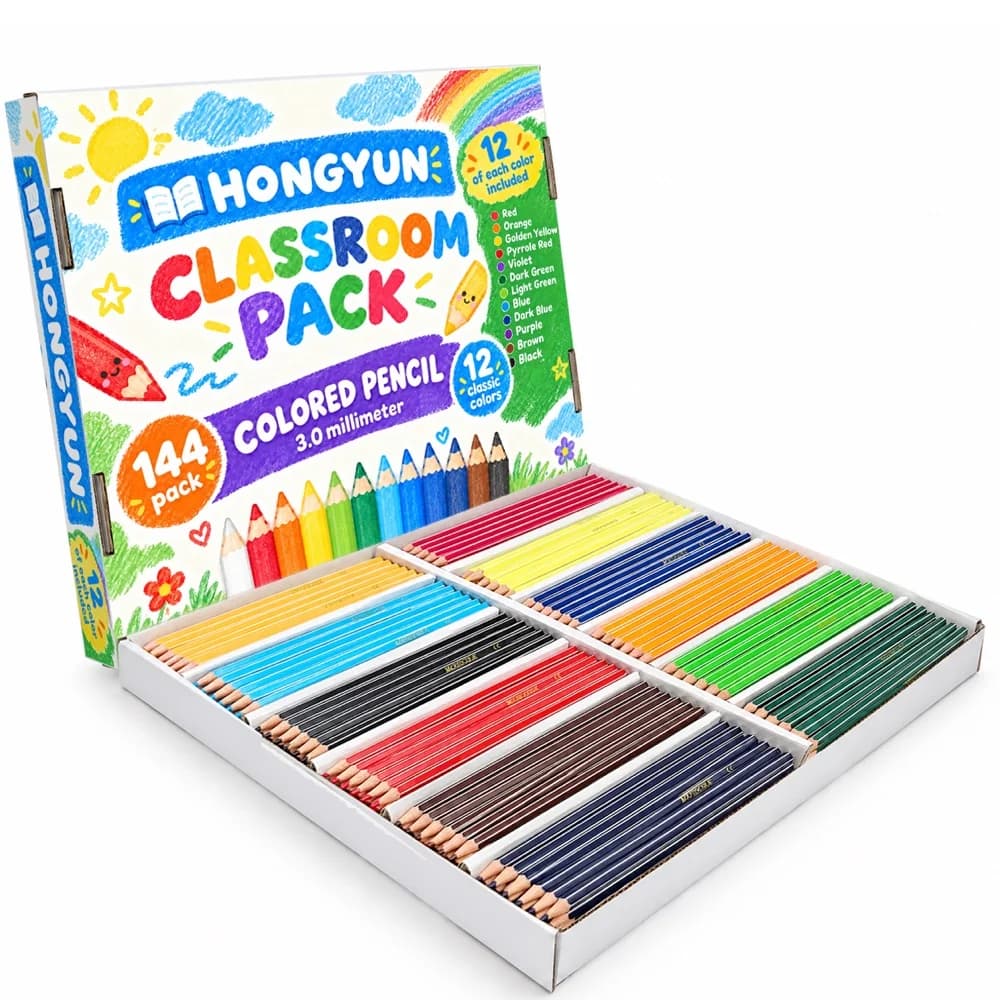
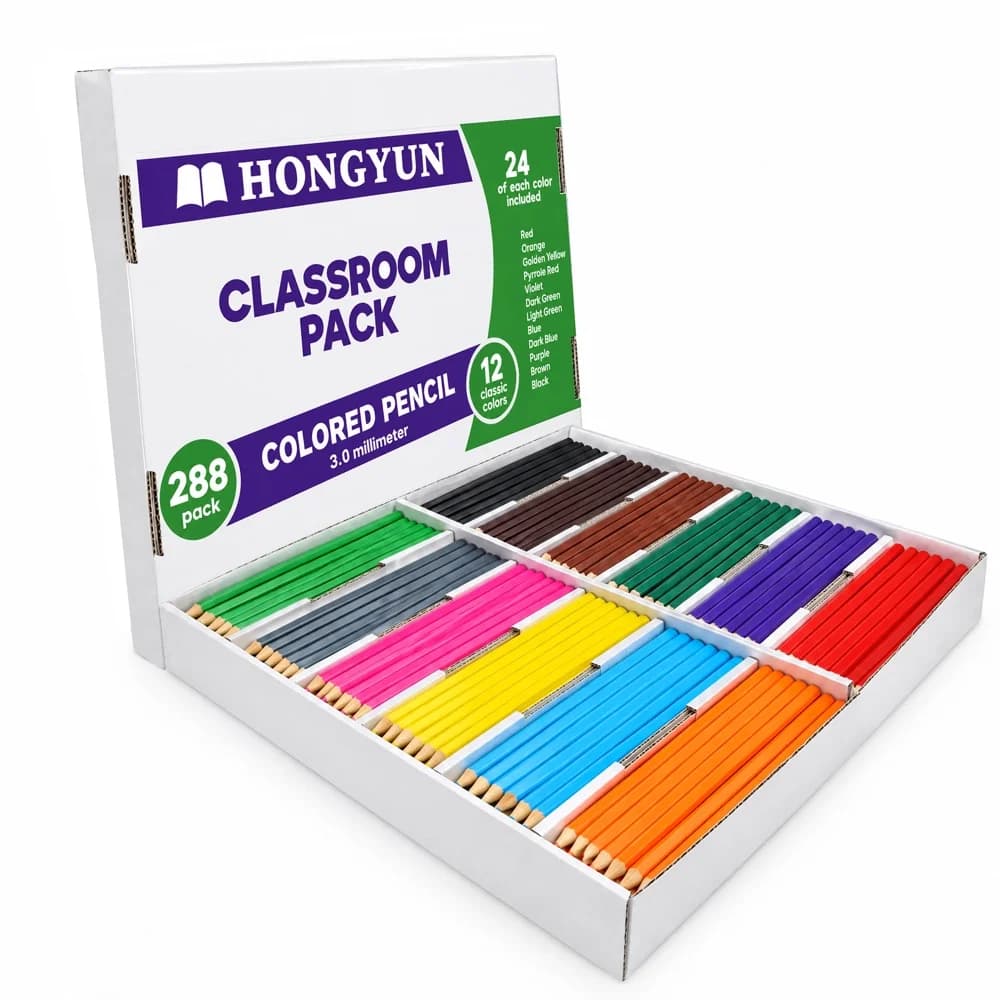
4. Custom Display Box / Bulk Carton (for school supply and promotional programmes). Standard cardboard boxes in custom dimensions with your branding printed on the exterior. Options include: window box (die-cut window with transparent film showing the pencils inside), tuck-top box, and rigid two-piece box. For bulk promotional pencils (unbranded or single-colour imprint), standard packaging is a corrugated bulk carton with 144–1,000 pencils per carton, or poly-bagged bundles of 12–50 pencils with a branded header card. Bulk carton packaging adds minimal cost (USD 0.005–0.01 per pencil) but provides no retail shelf presentation — suitable for programmes where the pencils are distributed at events, included in other products, or sold from a countertop display.

Packaging decisions should be made at the artwork stage, not after production. Changing packaging format mid-production adds 2–4 weeks and USD 500–1,500 in repacking costs. Request packaging samples alongside your pencil PP samples to verify fit, print quality, and barcode scannability before committing to the full production run.

What is the OEM pencil sample approval process and how long does it take?

The OEM pencil sample approval process has four stages, each with a fixed timeline. Understanding these stages prevents the most common sourcing delay — buyers who treat the sample stage as optional discover production problems at pre-shipment inspection, when correction costs are 10× higher.

Stage 1 — Digital artwork proof (2–3 business days). You submit your logo in vector format (AI, CDR, or PDF). Our design team prepares a digital mockup showing the logo position, size, and colour on the pencil barrel. For Pantone-matched colours, we specify the exact Pantone code on the proof. You approve the digital proof or request revisions — each revision round adds 1–2 business days. Tip: approve the digital proof in one round by including all feedback in your first response.

Stage 2 — Pre-production sample (5–7 business days). Once the digital proof is approved, we produce a physical pre-production (PP) sample — a small batch of finished pencils with your exact logo, colour, and packaging. This is the contractual anchor point: the PP sample becomes the reference standard for the entire production run. We ship the PP sample to you via courier (typically DHL/FedEx, 3–5 business days transit). You evaluate: logo print accuracy (colour match, alignment, sharpness), barrel colour against your Pantone reference, pencil dimensions (length, diameter, shape), sharpening quality (clean cut, no splintering), and packaging fit and finish. Sign off in writing once approved.

Stage 3 — Production (15–25 business days from PP sign-off). Production begins only after written PP sample approval. The approved sample stays on the production floor as the visual reference standard for QC inspectors. Any deviation from the approved sample during production triggers a line stop and correction.

Stage 4 — Pre-shipment inspection (2–3 business days). At 80%+ production completion, a third-party inspector (SGS, QIMA, or V-Trust) samples the production run against AQL 2.5 standard, comparing every sampled unit against the approved PP sample. Inspection report confirms conformance before container loading.

Total timeline from artwork submission to production start: 10–14 business days (including courier transit). The most common buyer mistake is skipping the PP sample to save 10 days — this shifts quality verification from the sample stage (where corrections cost nothing) to the pre-shipment stage (where corrections cost the entire production run). Never skip the PP sample.

Related Articles

Sourcing GuideComparing Pencil Manufacturers in China: What Separates the Best from the Rest10 min readSourcing GuideThe True Cost of Importing Pencils from China: Hidden Costs Most Buyers Miss9 min readSourcing GuidePencil Sourcing Calendar for European Retail Buyers: When to Order for Every Season8 min read

Ready to Source Custom Pencils?

Request samples or a quotation — we respond within 24 hours.

Get a Quote→
Hongyun — pencilschina.com

From inquiry to delivery — certified, on time, documented.

Direct from Qingyuan, the world's largest pencil manufacturing cluster. FSC-COC ESTS-COC-251233. Exporting to 50+ countries since 2004.

sales@pencilschina.com+8613372508907@pencilschina@pencilsChinaDavid Wu

Products

  • Wooden Pencils
  • Colored Pencils
  • Watercolor Pencils
  • Wood-Free Pencils
  • Specialty Pencils

Certifications

  • FSC Certified
  • BSCI Certified
  • ISO 9001
  • ICS Certified
  • Institutional & Tender

Company

  • About Us
  • Our Factory
  • Why Qingyuan
  • OEM & Custom
  • Custom Packaging
  • Blog
  • Our Team
  • Glossary
  • Contact

Markets

  • Export Markets

Resources

  • Eco-Friendly Pencils
  • Sell on Amazon
  • EU Pencil Safety
  • EU Pencil Compliance
  • Buyer's Guide
  • Manufacturing Standards
  • Compliance Data Center
  • Sourcing Checklist
  • Case Studies
  • OEM Design Guide
  • Editorial Policy

Get Started

  • Request a Sample
  • Get a Quote
  • Privacy Policy
  • Terms of Use

Our Certifications

Forest Stewardship Council logo
FSC
Business Social Compliance Initiative logo
BSCI
ISO 9001 Quality Management logo
ISO 9001
Initiative Clause Sociale logo
ICS

© 2026 pencilschina.com. All rights reserved.

Unified Social Credit Code: 913311267613355427

Editorial PolicyPrivacy PolicyTerms of Use