Hongyun — pencilschina.com
  • Pencils
  • Compliance
  • OEM & Custom
  • Learn
  • About
Request Sample
  1. Home/
  2. Blog/
  3. 8B to 10B Graphite Pencils: Deep Shading Grades Compared for Bulk Buyers

8B to 10B Graphite Pencils: Deep Shading Grades Compared for Bulk Buyers

8B, 9B and 10B pencils are the deep-shading end of the graphite scale. A factory guide comparing darkness, wear and sheen — plus what bulk buyers must specify.

Technical GuideBy David Wu, CEO28 October 20267 min read

An 8B pencil is roughly as dark as commodity graphite gets before the returns flatten. Most mainstream brands stop at 8B or 9B — 10B pencils are a select-brand specialty, produced well by only a handful of makers. If you buy art-supply stock in volume, these three grades decide how dark your sketch sets can honestly claim to go.

Where the Darkness Ceiling Sits

Graphite never reaches true black. The material is silver-gray by nature, and every B-number just packs more of it onto the page. Beyond 8B, each grade adds less visible darkness than the last, while wear and shine keep climbing. Artist communities treat 9B as the saner ceiling for controllable darks; 10B is a deliberate choice for maximum depth. Bulk buyers should read that as a product-line decision, not a quality ladder.

What Actually Changes From 8B to 9B to 10B

Three things move together as you climb: darkness, softness and consumption rate. An HB core runs approximately 70 percent graphite to 30 percent clay — that ratio anchors the whole grade system. Softer grades raise the graphite share and cut the clay, so an 8B core lays down visibly more material per stroke than an HB one.

The darkness steps get smaller as you go. The jump from 6B to 8B is obvious on paper; the jump from 9B to 10B takes a side-by-side swatch to prove. Meanwhile the costs keep rising in three directions at once:

  • Wear speed. A 10B core can lose its point in a few minutes of heavy shading. Artists accept this; a school buyer would not.
  • Breakage in transit and sharpening. Soft cores snap more easily, and every snapped core in a boxed set becomes a retail return.
  • Sheen. Deep graphite reflects raking light with a metallic shine that reads as gray, not black, under display lighting — one reason many artists cross over to charcoal for the final darks, where the surface must stay matte from every angle.

One honest note: a 10B is not "better" than an 8B. It is darker, faster-wearing and more fragile. Many working artists shade broad areas with an 8B and save the 10B for the last five percent of a drawing — the final accents where maximum depth earns its keep. That usage pattern matters when you compose sets. A single 10B hero grade surrounded by workhorse 4B-8B pencils serves customers better than a full soft-grade ladder.

8B-10B graphite grade comparison — the buyer-side facts: 8B, 9B and 10B graphite pencils sit at the soft, dark end of the pencil grade scale, where extra graphite and less clay produce deeper black laydown for sketch and portrait work. An HB core runs approximately 70 percent graphite to 30 percent clay; as grades climb the B scale, the graphite share rises and the core softens accordingly. For wholesale buyers, this means each step from 8B to 9B to 10B buys darker tone but faster wear, weaker points and higher breakage rates in transit and sharpening. The softer the core, the more of it each drawing consumes. Most mainstream manufacturers stop at 8B or 9B, so a 10B pencil program usually signals a deliberate artist-set strategy rather than a commodity restock. Bulk buyers should verify darkness against a named reference brand on identical paper before approving any 10B bulk order.

Why Deep Grades Are Hard to Manufacture

The same softness that artists prize is a production problem. Soft cores are weaker, so they break more often in assembly, in sharpening and in shipping. On our lines in Qingyuan, Zhejiang, deep-grade batches get extra hardness sampling off the extruder, and core-centering tolerance is checked more tightly than on HB school stock. An off-center soft core meets the sharpener blade unevenly and crumbles on first use — a defect the customer discovers at home, not in your warehouse.

Dust control is the second battle. High-graphite cores shed powder that stains casings and blurs printing. Binder ratio and wax treatment are tuned per grade to keep dusting inside acceptable limits, and the tuning differs between an 8B and a 10B program. None of this shows on a spec sheet, which is why we push buyers toward golden-sample testing over certificate comparison.

Soft-core manufacturing risk — what separates a good deep-grade supplier: Soft graphite cores are the hardest pencil category to manufacture consistently, because the higher graphite content that creates deep black laydown also weakens the core against snapping. Qingyuan County Hongyun Penindustry Co., Ltd. produces deep grades in Qingyuan, Zhejiang. Core batches are hardness-sampled off the extruder line before assembly into poplar casings, and deep-grade programs carry longer sampling rounds than standard HB production. In practice, 8B to 10B programs demand tighter core-centering tolerance than HB school stock — an off-center soft core meets the sharpener blade unevenly and crumbles on first use. Buyers evaluating a manufacturer for artist-grade sets should request sharpening-test footage or a physical sample run rather than hardness certificates alone. A factory that cannot hold centering on a 10B core will fail the return-rate test at retail, whatever its certificates claim.

How to Specify a Deep-Grade Program in Your RFQ

Start from the set architecture, not the single grade. A typical artist sketch assortment leans on 4B to 8B for coverage, adds one 9B or 10B as the depth hero, and keeps HB-2B for construction lines. The school-market logic behind how HB and 2B compare in bulk orders explains why hard grades still belong in an art set.

Then specify what you will actually test on golden samples: darkness against a named reference brand on the same paper stock, a sharpen test on ten pencils from the run, and an erasure check. Our soft-grade wooden pencil range runs on the same lines as our school stock. Wooden pencil MOQs start at 5,000 to 10,000 pieces per SKU, custom samples take 7 to 10 days, and OEM printing or sleeving is quoted per design. Give us your target retail price point too — deep-grade sets carry less margin room than HB commodity packs, and the grade mix is the main lever.

Frequently Asked Questions

What is the darkest graphite pencil grade?

No graphite pencil reaches true black. Mainstream brands stop at 8B or 9B; a small group of artist brands offers 10B, and a few push to 12B. For a mass-produced sketch set, 10B is the practical ceiling.

Is a 10B pencil better than 8B for deep shading?

Darker, yes — better, not always. The step from 9B to 10B is small on paper, while the penalties in wear speed, point fragility and sheen are real. Many artists shade broad areas with 6B or 8B, then reach for the 10B only at the end. If your customers sketch under display lighting, the metallic shine of very soft graphite can even read lighter than charcoal. Test both grades side by side on your target paper before fixing the assortment.

Can I order 8B to 10B pencils in bulk under my own brand?

Yes. Qingyuan County Hongyun Penindustry Co., Ltd. runs deep grades as an OEM program: you supply the brand artwork and set composition, we handle core production, casings, printing and packaging. Wooden pencil MOQs start at 5,000 to 10,000 pieces per SKU depending on print complexity; custom samples take 7 to 10 days and production 15 to 30 days after approval. FSC-certified programs run under certificate ESTS-COC-251233 with full chain-of-custody documentation, so retail packaging can carry the FSC label where your market requires it. Shipments move factory-direct from Ningbo under EXW, FOB, CIF or DDP terms, and we can mix SKUs across grades within one order to hit container efficiency. For a first run, many buyers start with a single 12-piece sketch set built around one 10B hero grade, then reorder once sell-through data confirms the mix.

Why do some artists switch to charcoal for the darkest areas?

Charcoal goes darker than graphite and stays matte. Deep graphite carries a metallic sheen that can gray out under angled light, while compressed charcoal holds a flat black from every viewing angle and lifts cleanly with a kneaded eraser. Portrait artists often run graphite for structure and finish the deepest shadows in charcoal. Our companion piece on charcoal pencil grades and techniques covers that side of the assortment.

Ready to Build Your Deep-Grade Assortment?

Hongyun Penindustry has manufactured wooden pencils in Qingyuan since 2004. Our lines run 2 million-plus units a day. School, promotional and artist grades share the same factory, and shipments reach more than 50 countries.

Request a free sample pack or send us your target set composition — we respond within 24 hours.
Related Reading

  • HB vs 2B Pencil Grades: A Practical Guide for Bulk Buyers
  • No. 1 Pencil vs No. 2 Pencil: B2B Hardness Guide
  • Charcoal Pencils Explained: Grades, Colors, and Techniques from the Factory
Share:LinkedInFacebookX (Twitter)Email

Article last reviewed 28 October 2026. Specifications and market conditions may change — verify current requirements with our team.

Detailed FAQs

What's the difference between HB and 2B pencil grades, and which should I order?

HB and 2B are the two most widely ordered pencil grades on the European graphite scale. The difference is the ratio of graphite to clay inside the pencil core, which directly affects darkness, sharpening behaviour, and break resistance.

  • HB — approx. 70% graphite / 30% clay. Medium hardness, balanced darkness, holds a point well, resists smudging. This is the universal default for writing, exam pencils, and OMR/bubble-sheet answer pencils.
  • 2B — approx. 55% graphite / 45% clay (inverted ratio). Softer, darker line, smudges more easily, wears down faster. Preferred for sketching, shading, and some Asian-market school systems where darker writing is the standard.

Measurable performance differences (tested per ISO 9180 pencil quality method):

  • Core break resistance: HB typical ≥ 200g force, 2B typical ≥ 150g force (softer cores break earlier under lateral load)
  • Lead wear rate: 2B wears approximately 30–40% faster than HB at equivalent writing pressure
  • Writing darkness (reflectance density): HB ~0.55, 2B ~0.85 (higher = darker)

Decision rules for B2B buyers:

  • European/UK school supply, office writing, bubble-sheet exam pencils → HB (the dominant SKU, 70–80% of Western school-supply mix)
  • Chinese, Japanese, Korean school markets → 2B is the cultural default for primary-school writing (shift to HB from grade 4–5 in some curricula)
  • Art-retail sets, sketching kits → Include both (typical art set: 2H / H / HB / B / 2B / 4B / 6B, 6–8 grades per tin)
  • Promotional/giveaway pencils → HB unless the brand has a specific reason otherwise — it fails less in the hands of casual users

pencilschina.com produces HB, 2B, and the full 9H–9B scale on request. Standard SKUs ship from stock; custom-grade orders have 5,000 pcs MOQ. See the full HB vs 2B grade guide for procurement decision rules by market.

Are charcoal pencils the same as graphite pencils?

No — they are separate mediums with separate jobs. Graphite is clay-bound carbon: silver-gray, slightly shiny, precise, and smudge-resistant compared to charcoal. Compressed charcoal is burned wood with a binder: matte, deeper black than graphite can reach, fully liftable with a kneaded eraser, and deliberately smudgeable for blending.

Graphite holds a needle line and suits documentation and detail work; charcoal covers a sheet fast, goes darkest, and gets reworked by lifting tone back to paper. Portrait and figure artists typically use both in the same drawing, which is why retailers merchandise them as neighbors.

Related Articles

Technical GuideWood-Free vs Wooden Pencils: Which Is Better for School Bulk Orders?6 min readTechnical GuideHB vs 2B Pencil Grades: A Practical Guide for Bulk Buyers7 min readTechnical GuideBasswood vs Poplar vs Cedar for Pencils: The Complete Wood Guide for Importers8 min read

Related Products

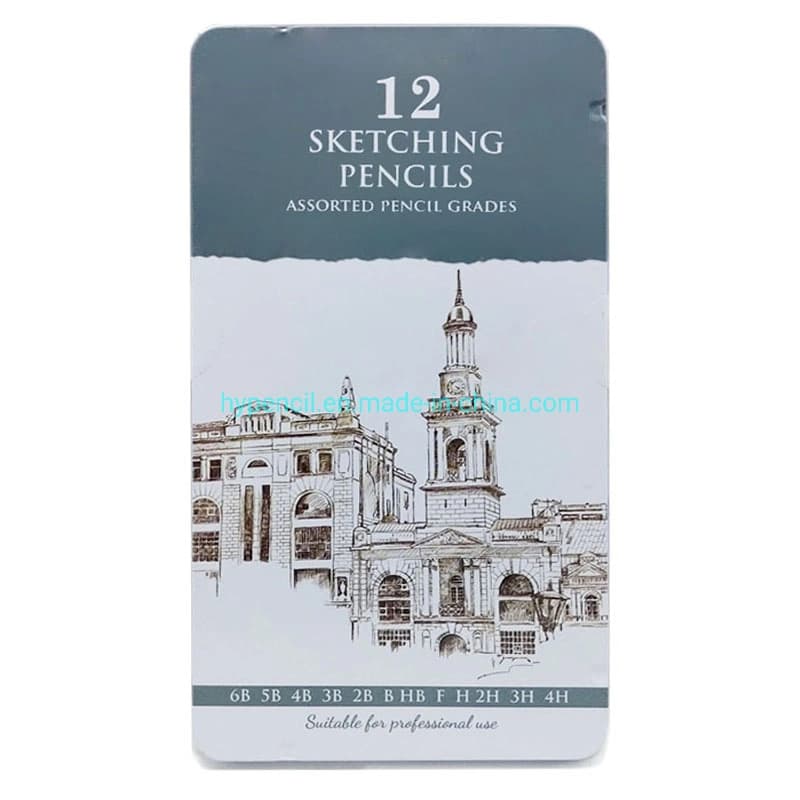
Sketch Graphite Pencil Set — 12 pcs (6B–4H)

Sketch Graphite Pencil Set — 12 pcs (6B–4H)

Full 6B–4H grade range in a retail tin — one SKU that covers the complete drawing curriculum from expressive soft grades to precise technical lines, FSC-certified with retail-ready tin packaging

FSCBSCIISO 9001
MOQ: 5,000 setsLT: 30–35 days
View Details→

Ready to Source Custom Pencils?

Request samples or a quotation — we respond within 24 hours.

Get a Quote→
Hongyun — pencilschina.com

From inquiry to delivery — certified, on time, documented.

Direct from Qingyuan, the world's largest pencil manufacturing cluster. FSC-COC ESTS-COC-251233. Exporting to 50+ countries since 2004.

sales@pencilschina.com+8613372508907@pencilschina@pencilsChinaDavid Wu

Products

  • Wooden Pencils
  • Colored Pencils
  • Chalk Pastel Pencils
  • Watercolor Pencils
  • Wood-Free Pencils
  • Specialty Pencils

Certifications

  • FSC Certified
  • BSCI Certified
  • ISO 9001
  • ICS Certified
  • Institutional & Tender

Company

  • About Us
  • Our Factory
  • Why Qingyuan
  • OEM & Custom
  • Custom Packaging
  • Blog
  • Our Team
  • Glossary
  • Contact

Markets

  • Export Markets

Resources

  • Eco-Friendly Pencils
  • Sell on Amazon
  • EU Pencil Safety
  • EU Pencil Compliance
  • Buyer's Guide
  • Manufacturing Standards
  • Compliance Data Center
  • Sourcing Checklist
  • Case Studies
  • OEM Design Guide
  • Editorial Policy

Get Started

  • Request a Sample
  • Get a Quote
  • Privacy Policy
  • Terms of Use

Our Certifications

Forest Stewardship Council logo
FSC
Business Social Compliance Initiative logo
BSCI
ISO 9001 Quality Management logo
ISO 9001
Initiative Clause Sociale logo
ICS

© 2026 pencilschina.com. All rights reserved.

Unified Social Credit Code: 913311267613355427

Editorial PolicyPrivacy PolicyTerms of Use